- About Us
- Business overview
- Products & Services
- Activities
- Recruit

Contact
MENUCLOSE
The First Penguin
Company
Company
Contact
MENUCLOSE


2026/07/29

From July 1, 2026, all agricultural, forestry, and fisheries food production and business establishments nationwide—from cooperatives to supermarkets, from school kitchens to traditional markets—will be required to publicly provide product traceability information in accordance with the latest regulations issued by the Ministry of Agriculture and Environment.
The question is no longer “Is it necessary?” but rather: How can businesses achieve full compliance and avoid penalties?
Agricultural product traceability is the process of recording, storing, and publicly disclosing all information related to agricultural, forestry, and fisheries products throughout the entire supply chain—from cultivation areas, production facilities, harvesting, and processing to transportation and final delivery to consumers.
According to the Implementation Plan for Agricultural, Forestry, and Fisheries Product Traceability for the 2026 ~ 2030 Period, recently issued by the Ministry of Agriculture and Environment, the key objectives are:
This is not a recommendation – It is a mandatory implementation roadmap with a clearly defined timeline.
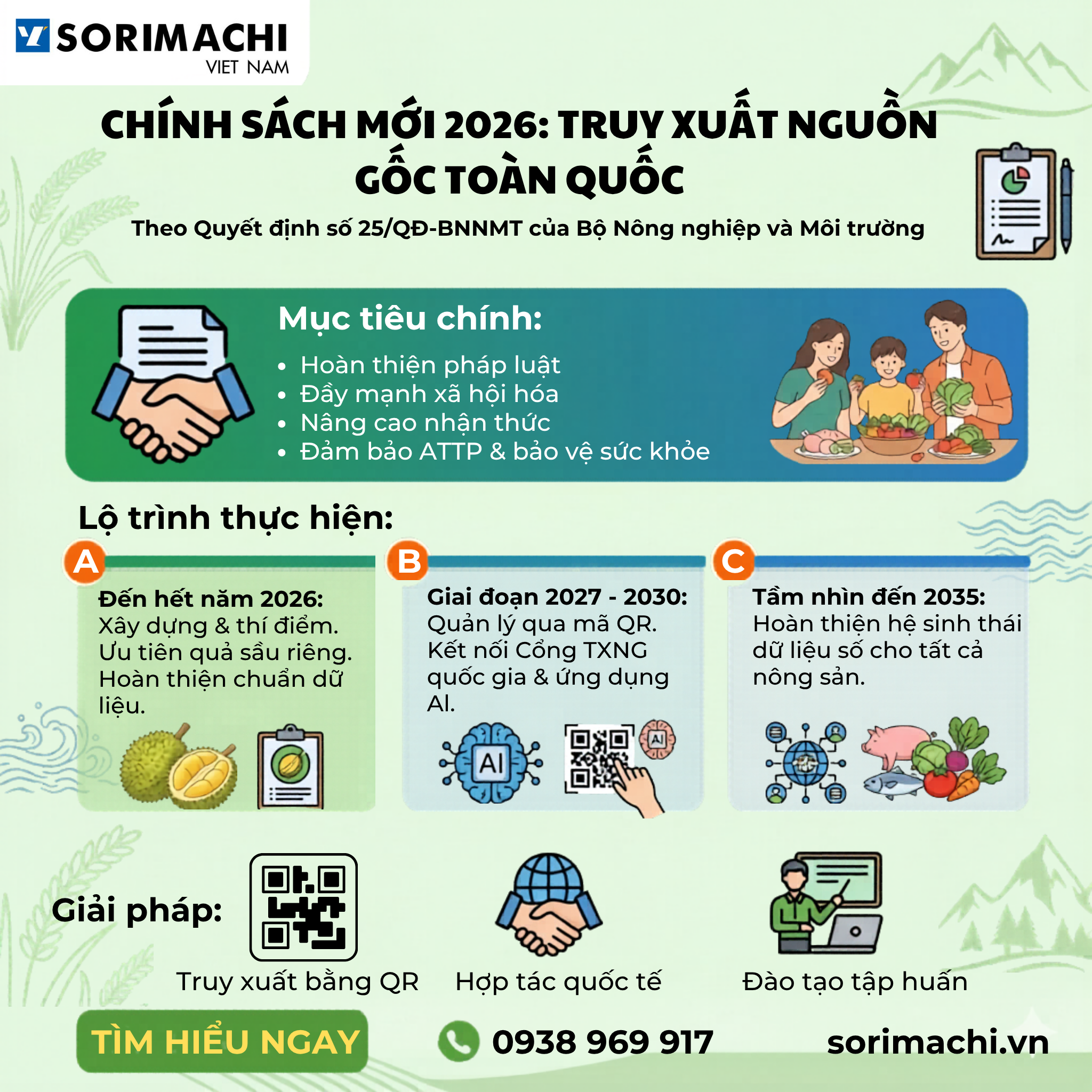
The National Agricultural Product Traceability System will officially become operational at traceviet.mae.gov.vn, covering most key agricultural products intended for food consumption.
Each product must include at least the following traceability information:
Durian will be the first product prioritized for implementation (pilot program beginning in early 2026), followed by the expansion to all major agricultural products.
The scope of traceability information will be expanded to cover every stage of the supply chain:
Production Area → Procurement → Processing/Packaging → Transportation → Distribution
At the same time, the system will be fully integrated with the National Traceability Information Portal and local traceability systems, while AI technologies will be deployed to detect anomalies and provide risk alerts throughout the supply chain.
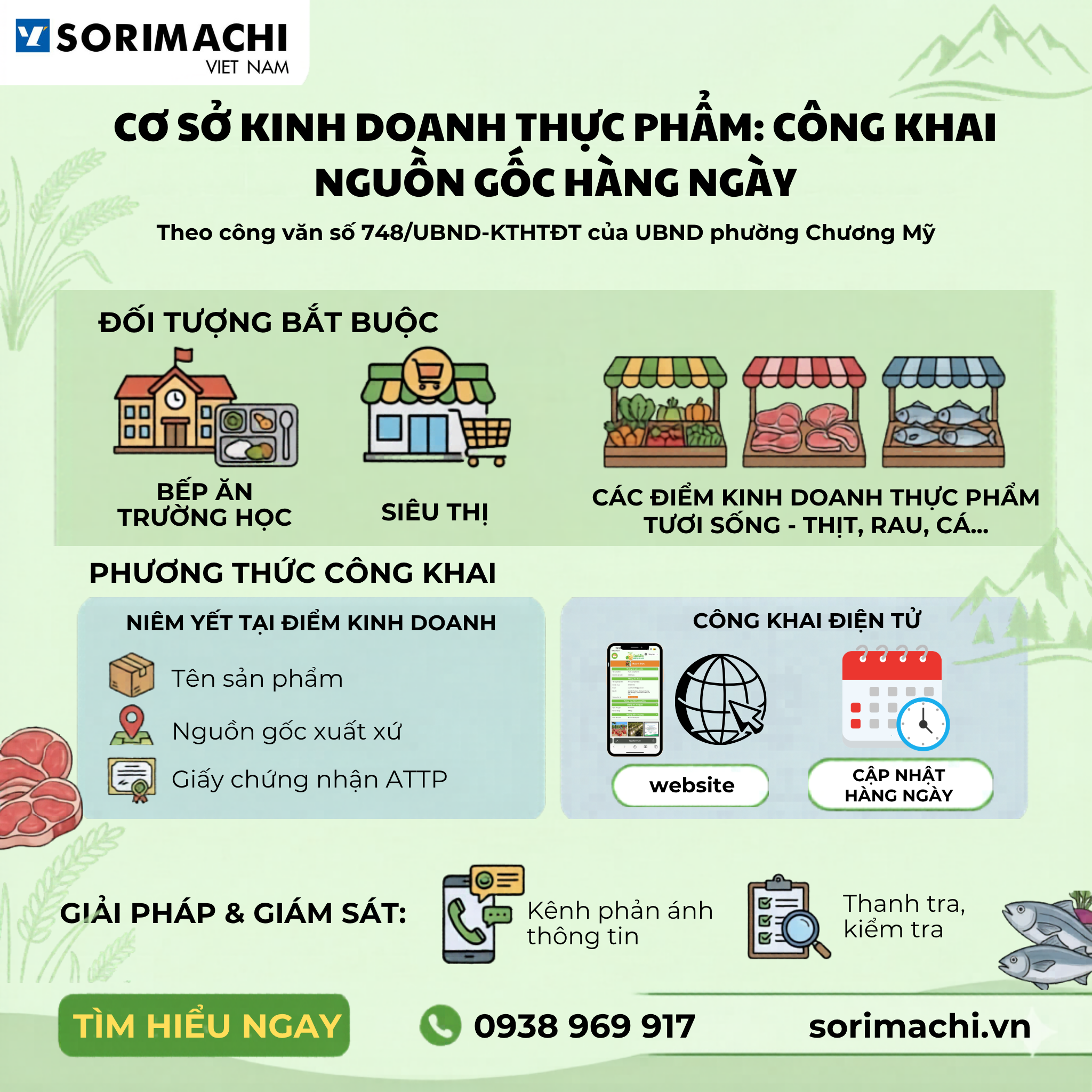
Under the current food origin disclosure guidelines, the following entities are required to implement product traceability:
The minimum information that must be publicly disclosed for each shipment on a daily basis includes: Product name, name and address of the producer or supplier, product origin, relevant food safety certifications accompanying the product.
Display traceability information in a location that is easily accessible to consumers. The information must be updated daily for each incoming batch of products. Businesses must also retain invoices, supporting documents, and food safety certificates for inspection and verification when required.
Traceability information may be disclosed through:
For electronic disclosure, more comprehensive information is required, including product images, supply chain event records compliant with TCVN 12850 or GS1 standards, batch/lot numbers, expiration dates, and applicable technical standards.
Although the regulations are becoming increasingly clear, many agricultural cooperatives and production facilities still manage their operations manually, with fragmented processes and no integrated management system.
As regulatory requirements continue to increase, adopting a digital agricultural production log software solution is no longer an option—it has become essential for remaining competitive in the market.
FaceFarm is an agricultural production log software developed by Sorimachi Vietnam, leveraging the technology platform and decades of agricultural management expertise of Sorimachi Japan.
Since 2022, FaceFarm has been deployed nationwide in collaboration with the Department of Cooperative Economy under the Ministry of Agriculture and Environment, supporting more than 6,000 cooperatives and 10,000 users across Vietnam.
✅ QR Code-Based Product Traceability
Every product managed through the FaceFarm system is assigned a unique QR code. Consumers and inspectors can simply scan the code to instantly access information about the production area, cultivation records, and harvest date.
✅ Compliant with Circular No. 02/2024/TT-BKHCN and current traceability regulations
The system is designed in accordance with current legal requirements, enabling cooperatives and businesses to confidently meet regulatory inspections with compliant traceability data.
✅ Digital Farming Log with comprehensive input management
Record fertilizers, crop protection products, animal feed, and veterinary medicines in a digital production log that complies with the production area record requirements under the Ministry’s 2026–2030 Implementation Plan.
✅ Supporting documentation for VietGAP, GlobalGAP, production area codes (MSVT), OCOP, and new rural development programs
Standardized production log templates help significantly reduce the time required to prepare certification documentation.
✅ Digital map management (Google Maps)
Manage and identify each production area using real geographic coordinates, supporting production area verification requirements under the National Traceability System.
✅ Available on both web and mobile applications
Farmers and cooperative staff can update production data anytime, anywhere—without requiring a computer or paper records.
|
Target Users |
Key Benefits |
|
Agricultural Cooperatives |
Centrally manage multiple-member households and generate synchronized QR codes for product traceability. |
|
Farmers |
Easily maintain digital production logs onto a mobile phone and prepares the required documentation for certification. |
|
Processing and Packaging Facilities |
Track raw material inputs and establish a transparent supply chain. |
|
Procurement and Export Businesses |
Meet traceability requirements imposed by export markets. |
|
Suppliers to Schools and Institutional Kitchens |
Comply immediately with local regulations on public disclosure of product origin. |
Identify whether your organization falls under the mandatory or recommended category. If you supply food to schools or sell fresh unpackaged food products, compliance is mandatory and should be implemented immediately.
Use agricultural production log software such as FaceFarm to replace manual paper-based records with digital records. These records form the foundation for generating QR codes for product traceability.
Register your products with the National Agricultural Product Traceability System (traceviet.mae.gov.vn) once the system officially becomes operational on July 1, 2026.
Under current regulations, organizations that are required to implement traceability but fail to publicly disclose traceability information, or disclose it in a non-compliant manner, may be subject to penalties in accordance with the applicable laws on food safety and product quality management. Commune- and ward-level authorities are authorized to conduct inspections and recommend enforcement actions.
Yes. Sorimachi Vietnam offers a 30-day free trial with full features, along with 24/7 user support via Zalo and telephone.
No. FaceFarm is specifically designed for farmers and agricultural cooperatives. It does not require advanced technical skills, features a simple user interface, runs on both Android and iOS devices, and includes on-site training support when needed.
All production data is securely stored on a cloud platform with continuous automatic backup, ensuring data safety and allowing users to access information anytime, anywhere.
Agricultural, forestry, and fisheries product traceability is no longer a matter for the future—it is a legal requirement taking effect in 2026. With a clearly defined implementation roadmap issued by the Ministry of Agriculture and Environment, cooperatives, farmers, and businesses should take proactive steps today to ensure they are fully prepared when the regulations come into force.
FaceFarm, the agricultural production log software developed by Sorimachi Vietnam, is a practical solution already trusted by more than 6,000 cooperatives. It enables QR code-based product traceability, standardizes digital production records, and supports the digital transformation of the agricultural value chain.
Contact us for consultation and a Free 30-Day Trial
Hotline: +84 938 969 917
Email: hotro@sorimachigroup.vn
Website: https://sorimachi.vn/
→ Visit the Product Portal section on the website to register for an account.
References: Implementation Plan for Agricultural, Forestry, and Fisheries Product Traceability for the 2026–2030 Period issued by the Ministry of Agriculture and Environment; Guidelines on Public Disclosure of the Origin of Agricultural, Forestry, and Fisheries Food Products No. 4454/SNNMT-CLTT, dated April 9, 2026.